

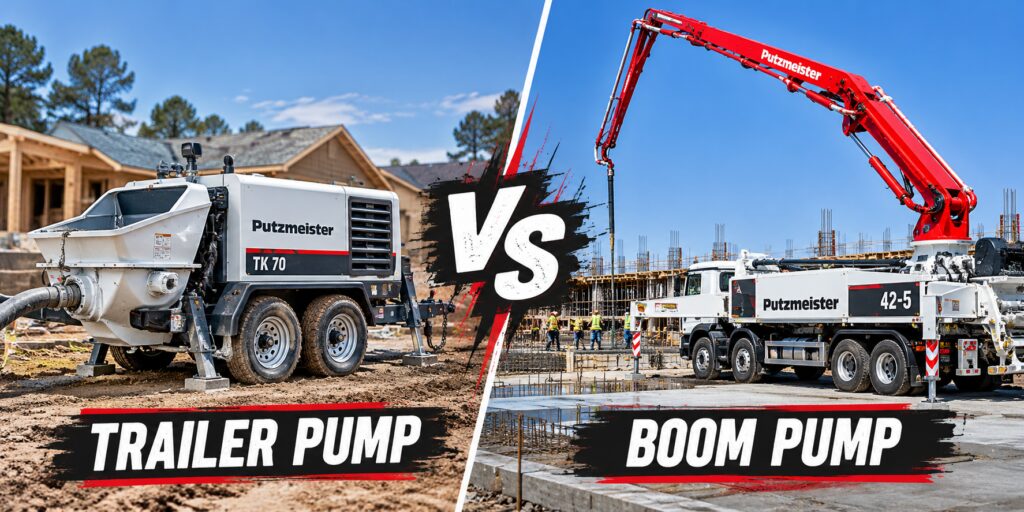
When shopping for a used concrete pump for sale, one of the first decisions you’ll face is whether to invest in a concrete boom pump or a trailer pump. Both types of concrete pumping equipment offer advantages, but choosing the right machine depends on your projects, budget, jobsite requirements, and long-term business goals.
Whether you’re considering a used Putzmeister boom pump, a Schwing concrete pump, an Alliance boom pump, or a used trailer pump from manufacturers like Mayco or Reed, understanding the differences can help you make a smarter investment.
At Concrete Pump Depot, we specialize in connecting buyers and sellers of quality used concrete pumping equipment, including boom pumps, trailer pumps, city pumps, placing booms, and truck-mounted conveyors.
Let’s break down the differences between boom pumps and trailer pumps, including their applications, operating costs, and what to consider when purchasing used equipment.
What Is a Concrete Boom Pump?
A concrete boom pump is typically a truck-mounted concrete pumping machine equipped with a hydraulic, articulating boom that carries the concrete delivery pipeline.
The boom allows operators to position the delivery hose at different locations around a construction site without manually relocating extensive lengths of pipeline.
Concrete boom pumps are commonly used for residential foundations, commercial buildings, industrial projects, and large-scale concrete placements.
Popular manufacturers include:
- Putzmeister concrete boom pumps
- Schwing concrete boom pumps
- Alliance concrete boom pumps
- KCP concrete boom pumps
- SANY concrete boom pumps
- Concord concrete boom pumps
- CIFA concrete boom pumps
- Everdigm concrete boom pumps
- DY and Beton Star concrete pumps
Advantages of a Concrete Boom Pump
1. Faster Setup and Concrete Placement
For many applications, a boom pump can reduce the time and labor required to position concrete delivery lines. The hydraulic boom can be maneuvered to different placement areas, helping contractors work efficiently.
2. Greater Placement Flexibility
Boom pumps are useful for projects requiring concrete placement over obstacles, at elevated locations, or across large work areas.
3. Reduced Manual Pipeline Handling
Because the boom supports much of the delivery system, crews may spend less time moving and assembling ground-level pipeline.
4. Versatility Across Projects
Depending on boom length and configuration, used concrete boom pumps can serve residential, commercial, industrial, and infrastructure projects.
Disadvantages of a Concrete Boom Pump
Despite their advantages, boom pumps may not be the best choice for every contractor.
- Higher initial purchase price than many trailer pumps
- More complex hydraulic and boom maintenance
- Greater transportation and operating expenses
- Larger setup areas and outrigger requirements
- Specialized inspection and operator training requirements
For contractors with consistent commercial work or projects requiring elevated concrete placement, a used Schwing, Putzmeister, Alliance, or KCP boom pump may offer the capabilities needed to expand their services.
What Is a Concrete Trailer Pump?
A trailer concrete pump, also called a stationary or line pump in many applications, is a portable pumping machine that is typically towed to the jobsite.
Instead of using an articulating boom, a trailer pump moves concrete through connected delivery hoses or pipelines.
Trailer pumps are commonly used for residential foundations, sidewalks, driveways, swimming pools, smaller commercial projects, and locations where boom access is limited.
Popular trailer pump manufacturers include:
- Putzmeister trailer pumps
- Schwing trailer pumps
- Mayco concrete pumps
- Reed concrete pumps
- SANY trailer pumps
Advantages of a Trailer Concrete Pump
1. Lower Initial Investment
For contractors entering the concrete pumping industry, purchasing a used trailer concrete pump may provide a more affordable starting point than buying a truck-mounted boom pump.
2. Access to Restricted Jobsites
Trailer pumps can be useful on properties with limited overhead clearance, narrow access roads, or other restrictions that make boom pump setup difficult.
3. Flexible Delivery Distances
With appropriate equipment and system design, trailer pumps can move concrete through substantial lengths of pipeline, making them suitable for projects requiring long-distance or specialized placements.
4. Potentially Lower Equipment Maintenance Costs
Trailer pumps generally have fewer mechanical systems than boom pumps because they don’t have an articulating hydraulic boom.
However, pipeline wear, pumping system maintenance, and labor requirements must still be considered.
Disadvantages of a Trailer Concrete Pump
- More labor may be required to install and move delivery lines
- Setup and cleanup can take longer
- Additional hoses, pipes, and accessories may be needed
- Elevated placements may require specialized pipeline configurations
- Manual pipeline handling introduces additional safety considerations
For smaller contractors, residential concrete specialists, and businesses just getting started, a used Putzmeister, Schwing, Mayco, or Reed trailer pump can be a practical investment.
Boom Pump vs. Trailer Pump: Side-by-Side Comparison
| Feature | Concrete Boom Pump | Trailer Concrete Pump |
|---|---|---|
| Initial purchase price | Generally higher | Generally lower |
| Concrete placement | Hydraulic articulating boom | Delivery hoses and pipelines |
| Setup labor | Often lower for suitable jobs | Often higher |
| Vertical reach | Based on boom configuration | Based on pipeline and pumping capabilities |
| Tight access | Requires room for truck and outriggers | Often better for restricted access |
| Maintenance complexity | Generally higher | Generally lower |
| Typical applications | Residential, commercial, industrial | Residential, commercial, specialized placements |
| Transportation | Truck-mounted | Requires suitable towing vehicle |
| Best suited for | Contractors needing reach and placement efficiency | Contractors prioritizing flexibility and lower equipment investment |
Neither machine is universally better. The right concrete pump depends on the type of work your company performs most frequently.
Which Concrete Pump Is More Profitable?
When comparing a used concrete boom pump vs. a used trailer pump, profitability depends on more than the purchase price.
A boom pump may generate higher revenue per job in certain markets because of its reach, placement capabilities, and efficiency. However, higher equipment costs, insurance premiums, fuel consumption, and maintenance expenses can offset that additional revenue.
A trailer pump may offer lower overhead, but operators must account for additional labor, pipeline setup, cleanup, and transportation.
Before purchasing either type of used concrete pumping equipment, evaluate:
- Average revenue per pumping job
- Number of jobs expected each month
- Equipment financing costs
- Operator and crew expenses
- Maintenance and repair budgets
- Fuel and transportation costs
- Insurance expenses
- Expected equipment utilization
The most profitable concrete pump isn’t necessarily the biggest or most expensive machine. It’s the one that consistently meets your customers’ needs while generating enough revenue to cover operating costs and produce a healthy return.
What to Look for When Buying a Used Concrete Pump
Whether you’re purchasing a used Putzmeister boom pump, used Schwing concrete pump, Alliance concrete pump, or a used Mayco or Reed trailer pump, equipment condition should be a top priority.
1. Maintenance and Service Records
Review available maintenance documentation and look for evidence of regular servicing, component replacement, and major repairs.
2. Pumping System Condition
Inspect wear parts, hydraulic systems, pumping cylinders, and other critical components.
3. Boom Condition and Inspection History
For used concrete boom pumps, review available boom inspection records and evaluate structural components, welds, pins, and hydraulic systems through a qualified inspector.
4. Truck Chassis Condition
If purchasing a truck-mounted concrete boom pump, consider engine condition, mileage, transmission performance, and the overall condition of the chassis.
5. Parts Availability
Before purchasing a used Schwing, Putzmeister, Alliance, KCP, SANY, Concord, CIFA, or other concrete pump, investigate parts availability and service support for that specific model.
6. Equipment Age and Hours
Machine age, pumping hours, boom hours, and overall usage history can help you assess equipment condition and future maintenance needs.
An independent inspection by a qualified concrete pump technician can help identify potential issues before you finalize your purchase.
Popular Used Concrete Pump Brands: Putzmeister, Schwing, Alliance, KCP & More
Manufacturer reputation, equipment condition, and service support are important considerations when buying used concrete pumping equipment.
Putzmeister: Known for manufacturing a broad range of concrete pumping equipment, including boom pumps and trailer pumps.
Schwing: A well-established manufacturer offering concrete boom pumps, stationary pumps, and other concrete pumping solutions.
Alliance: A recognized name in truck-mounted concrete boom pumps, offering multiple boom configurations and sizes.
KCP: Manufactures concrete boom pumps and other pumping equipment used across various construction applications.
SANY: Produces concrete pumping equipment, including truck-mounted boom pumps and stationary pumping systems.
Concord: Known for concrete boom pumps used in residential and commercial construction.
CIFA: Offers concrete pumping equipment, including truck-mounted boom pumps and stationary pumps.
Mayco and Reed: Established names frequently associated with trailer-mounted concrete pumps and line pumping applications.
When comparing brands, remember that a well-maintained used machine may be a better investment than a poorly maintained pump from a more recognizable manufacturer.
Should You Buy a Used Boom Pump or Trailer Pump?
If your business primarily handles residential slabs, foundations, sidewalks, and smaller concrete placements, a used trailer concrete pump may provide the capabilities you need at a lower initial cost.
If your company regularly works on commercial construction, elevated placements, or projects requiring greater reach, a used concrete boom pump may be the better option.
Contractors working across multiple project types should consider customer demand, jobsite access, equipment utilization, and long-term growth plans before making a purchase.
The best choice is the machine that fits your business today while supporting your plans for tomorrow.
Find Used Boom Pumps and Trailer Pumps at Concrete Pump Depot
Whether you’re searching for a used Putzmeister concrete pump for sale, a Schwing boom pump, an Alliance concrete pump, a KCP boom pump, or a used trailer pump from Mayco or Reed, Concrete Pump Depot can help you explore available equipment.
We specialize in connecting buyers and sellers of used concrete pumping equipment, including:
- Used concrete boom pumps
- Used trailer concrete pumps
- Used city pumps and truck-mounted line pumps
- Used placing booms
- Used truck-mounted conveyors
With decades of industry experience, Concrete Pump Depot understands the importance of finding equipment that meets your operational needs and budget.
Ready to Buy or Sell a Used Concrete Pump?
Browse our current inventory of used concrete pumps for sale at www.ConcretePumpDepot.com.
Whether you’re expanding your fleet, upgrading your equipment, or purchasing your first concrete pump, we’re here to help connect you with the right opportunities.
Concrete Pump Depot — Your Source for Used Concrete Pumping Equipment.